
Our numbers
What our video engine has made so far
Every Explain My Business video is drawn by our own software, not generated by an AI video model. One count covers every site our engine makes videos for, including this one: here is how much it has made, and what we estimate that saved, counted on 20 November 2026.
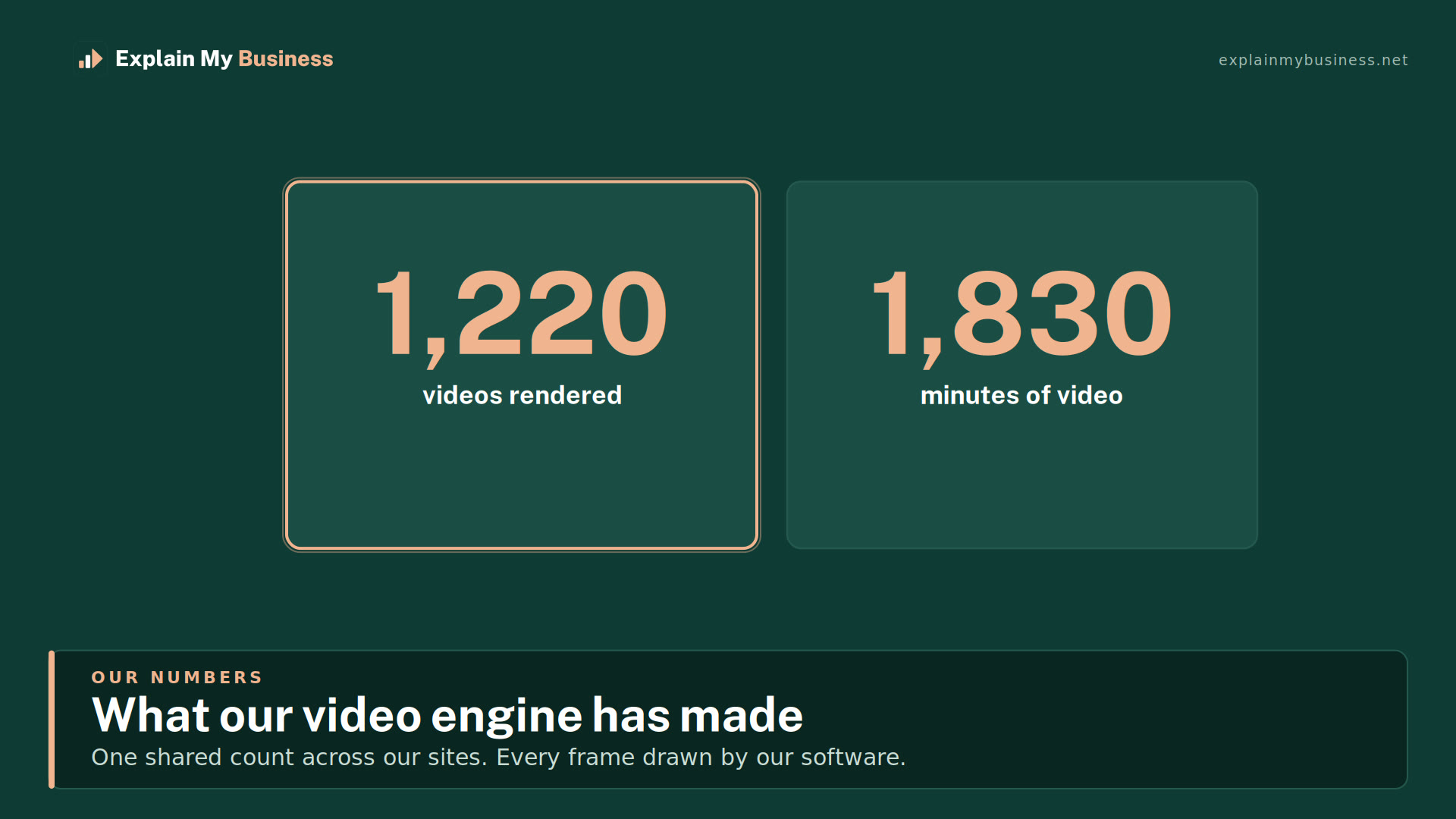
Our engine has rendered 1,507 videos (2,249 minutes). Making them with an AI video model instead would have used an estimated 1.1 MWh more electricity and about 25–73 kg more CO2e (our central estimate; the range runs from the UK grid average to our electricity supplier's stated mix), our own AI drafting included. How we estimate it.
Key numbers
- 1,507videos rendered
- 2,249minutes of video
- 1.1 MWhless electricity than an AI video model, estimated
- 25–73 kgCO2e avoided, estimated: UK grid average to our supplier's stated mix
Estimates against an AI video model, our own electricity taken off first.
How we estimate the electricity
We compare each video with one take of AI-generated footage of the same length from an open AI video model, measured on the same computer as ours in September 2026. We are conservative on purpose: we assume the AI video model gets every video right first time, use its lowest measured rate, and take our own electricity off first, including drafting every script with an AI language model. A whole 70-second video of ours, its AI script drafting included, used about 50 to 90 watt-hours in that measurement.
The full method, its carbon factors and the monthly charts are published on our sister site: explainapaper.com/our-numbers.
Your own videos' footprint
Each video in your account has a footprint table on its page, and your account page shows the total. Every figure there is an estimate, worked out like this:
- Drafting a script: 670 Wh each time, the top of our estimate for a whole working session of the AI drafting it, so it errs high. Its CO2e is at 384.4 g CO2e/kWh, the USA mix assumed for the provider's data centres.
- Saving your edits: nothing. It is one small request to our site, and we have no measurement that would support a figure.
- Rendering: 2.64 Wh for each minute of video, our highest measured rate, at 143.95 g CO2e/kWh (the UK grid average, DESNZ 2026) to 173 g CO2/kWh (our electricity supplier's stated mix, EDF Energy, April 2025 to March 2026). A revision is another render.
- Downloading: 0.059 to 0.139 kWh for each gigabyte, from the Sustainable Web Design Model (version 4): the network alone for the lower figure, and the network and data centres, including making their equipment, for the higher. Its CO2e runs from the UK grid average to that model's global average, 494 g CO2e/kWh. Watching a video on its page is streaming, which none of our figures include.
- Against an AI video model: your account page makes this comparison only for widescreen videos whose length we measured, one take of footage each, on the same basis as the figures above, and only when it is a saving in both electricity and CO2e. A short video may not be one, because drafting its script is counted generously.
Against a traditional animator: an estimate
Estimated, from published studio guides, not measured. Studio guides put a one-minute 2D animated explainer at 40 to 140 hours of skilled work. On an office workstation, at the UK government's figure of 150 watts, that is 6 to 21 kWh of electricity. One of our 70-second videos takes up to two hours of our staff's time and an estimated 0.2 to 1 kWh in all, counting the AI that helps draft the script as a whole working session. So even our highest estimate uses at least 6 times less electricity than the studio's lowest.
On price, a video is £39 before VAT, and UK animation studios' own price guides put a 60 to 90 second explainer in the thousands of pounds: see, for example, the guides of Hocus Pocus Studio and Mair Perkins, checked on 29 September 2026.
The assumptions: 40 hours is the lowest published figure for a minute of 2D work, before revisions, and 140 hours the top of the basic tier; premium work takes longer. The workstation figure is the one the UK government uses for an office computer, screen and printer. Travel, heating, a voice-over studio and your own time are left out on both sides. Hand animation is a different product, with a storyboard you shape and a human voice.
What this does not mean
Our videos still use electricity, and so does the AI that helps write their scripts. These are estimates of electricity not used compared with one alternative, not a claim that our videos have no impact. The footage an AI video model makes also could not show your document's text, data or charts, which is why we draw ours in code. For where AI is and is not used in a video, see AI and ethics.