
Copyright
Copyright and your video.
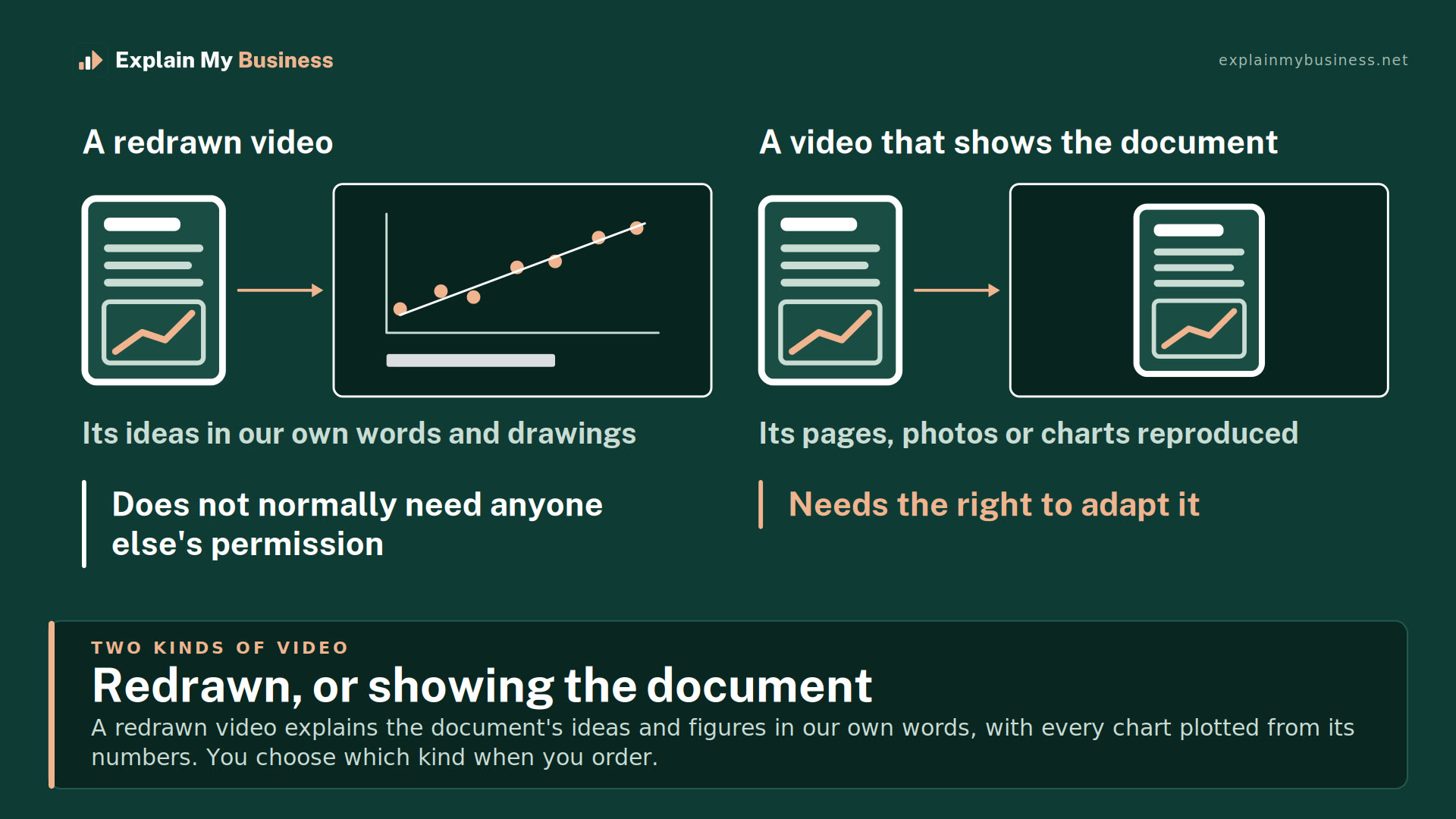
For your own business's documents, copyright is usually simple. Whether a video needs anyone else's permission depends on what it takes from the document: a video that shows the document's own pages and pictures needs the right to adapt them, and a video that redraws the ideas in our own words and pictures does not normally need it.
Ideas are free; their expression is not
Copyright protects the way a work is expressed: its words, its layout, its figures and its images. It does not protect the ideas, facts, methods or findings the work describes. This is the position in UK law and in the international treaties the UK has signed:
- The WTO's TRIPS Agreement, Article 9(2): "Copyright protection shall extend to expressions and not to ideas, procedures, methods of operation or mathematical concepts as such."
- The WIPO Copyright Treaty, Article 2: "Copyright protection extends to expressions and not to ideas, procedures, methods of operation or mathematical concepts as such."
- In the United States, 17 U.S.C. § 102(b): copyright does not "extend to any idea, procedure, process, system, method of operation, concept, principle, or discovery".
The line is not always sharp. Under the UK's Copyright, Designs and Patents Act 1988, section 16(3), copying "any substantial part" of a work infringes, as well as copying the whole. The House of Lords considered when taking ideas from a work amounts to copying a substantial part in Designers Guild v Russell Williams [2000] UKHL 58. So a redrawn video must genuinely redraw: a diagram traced from the document can still copy its expression.
What this means for the two kinds of video

A video that shows the document
Clips of the document's pages, its figures reproduced, or its text quoted at length all copy the document's expression, and a video made from them is an adaptation. It needs one of:
- your business owns the copyright, including in the photos, illustrations and charts in the document (work your staff made in the course of their jobs usually belongs to the business; work by a freelance designer or photographer may not, unless your contract says so);
- the copyright owner, such as a designer, a photographer, a stock library, a client or a supplier, has given permission; or
- an open licence that allows adaptations and commercial use: the public domain, CC BY, or CC BY-SA, whose share-alike terms then apply to the video.
CC BY-ND does not allow adaptations and CC BY-NC does not allow commercial use, so neither covers a video of this kind.
A redrawn video
A redrawn video copies no text or images from the document. It explains the document's ideas and figures in our own words, with every diagram redrawn and every chart plotted from the numbers the document reports, and it cites the document as typeset text. Because copyright protects how a document is written and drawn, not its ideas or facts, a video of this kind does not normally need anyone else's permission, whatever the document's licence.
Where a short quotation matters, such as a defined term, we keep it to a few words and attribute it. UK law allows fair dealing with a work for quotation, criticism or review, with sufficient acknowledgement (section 30 of the 1988 Act; see also the IPO's exceptions to copyright).
We still ask that you are entitled to share the document with us, because you upload it for us to read.
Other businesses' names and logos
A case study or a proposal often names a client or a supplier. Naming them to describe what you did is normal, but showing their logo, or suggesting they endorse you, needs their agreement. Check before you order, and tell us what may be shown.
Further reading
- UK Intellectual Property Office: How copyright protects your work and Exceptions to copyright.
- Copyright, Designs and Patents Act 1988 (legislation.gov.uk): section 16, the acts restricted by copyright, and section 30, criticism, review and quotation.
- Designers Guild Ltd v Russell Williams (Textiles) Ltd [2000] UKHL 58, on BAILII.
- WTO: the TRIPS Agreement, Part II, Article 9. WIPO: the WIPO Copyright Treaty.
- US Copyright Office: Circular 33, Works Not Protected by Copyright, and 17 U.S.C. § 102.
- Creative Commons licence deeds: CC BY, CC BY-SA, CC BY-NC, CC BY-ND and the Public Domain Mark.
This page explains how we decide what a video may show. It is general information, not legal advice about your document. If your position is unusual, tell us when you order and we will check it before we start, or ask a solicitor.